

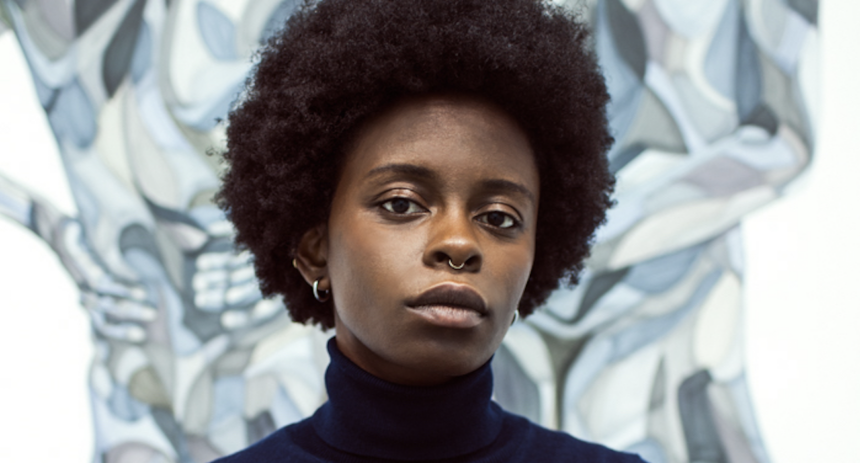
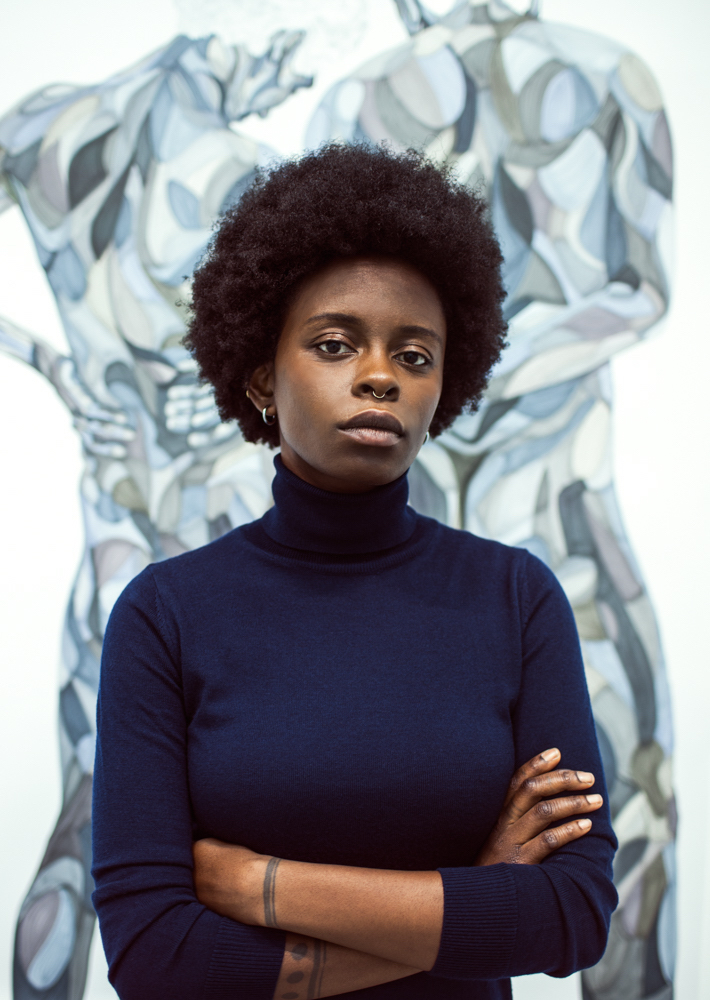
There’s a moment in Toyin Ojih Odutola’s New York studio when she pauses before a towering diptych, her eyes tracing figures that seem to breathe against layers of pastel and charcoal. The spirits of ancestors, she explains, are always present—entering every room with those who came before.
This isn’t a metaphor for the 39-year-old artist born in Ile-Ife and raised in Alabama. It’s the foundation of everything she creates.
In a breathtaking 2025 that saw her named to the TIME100 Next list—with a tribute from Zadie Smith calling her work “drawn like an old master”—Odutola has become something rare: a Nigerian artist whose ballpoint pen and charcoal build entire universes. Her large-scale drawings, often mistaken for paintings, command prices that reflect their cultural weight. At Sotheby’s, Representatives of State (2016) sold for $2 million, cementing her market dominance.

But numbers tell only part of the story.
The House of Abundance
Following her acclaimed presentation at the 2024 Venice Biennale’s Nigerian Pavilion, Odutola unveiled Ilé Oriaku at the Jack Shainman Gallery in mid-2025. The title itself is a quiet revolution—”Ilé” (Yoruba for house) joined with “Oriaku,” her late grandmother’s Igbo name—a linguistic marriage that, to many Nigerian ears, shouldn’t make sense. Yet for Ojih Odutola, it’s perfectly natural.
The exhibition emerged from grief. When her grandmother, Josephine Oriaku Ojih, died in 2023, the artist found herself speaking gibberish for a week, incomprehensible even to her parents. That dissociation seeped into her visuals. An audio track plays her grandmother’s voice, recorded in 2018, layered with birdsong taped after she received the news.
“Lẹhin Mgbede (Before + After the Evening’s Performance)” shows figures in states of preparation, with spectral faces hovering in the background—witnesses from beyond. “It’s that look of, ‘I know you’re worried, but just go ahead. You’re fine, you’re OK. Go ahead, I’m behind you,'” Ojih Odutola said of her grandmother’s enduring presence.
A World Stage
Her work currently transforms Berlin’s Hamburger Bahnhof into “Adijatu Straße,” a fictional underground station on the U22 line, exploring movement and identity through 25 drawings. The installation, running through January 2026, marks her first solo exhibition in Germany.
Across the Atlantic, she’s featured in Giants: Art from the Dean Collection at Richmond’s Virginia Museum of Fine Arts (through March 1) and The Time Is Always Now at the Philadelphia Museum of Art—exhibitions that place her alongside peers reframing the Black figure in contemporary art.
Her work lives permanently in the Whitney, MoMA, the Smithsonian’s National Museum of African Art, and London’s National Portrait Gallery—institutions that once seemed distant from the experiences she renders in intimate detail.
The Larger Canvas
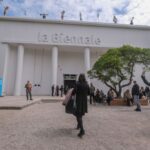
Odutola’s ascent reflects something deeper: Nigerian art has captured the world’s attention. At ART X Lagos in November, curators and collectors from London, New York, and beyond flew in to witness firsthand what critic Osei Bonsu calls “centuries of artistic innovation and cultural exchange”. Tate Modern’s “Nigerian Modernism” exhibition drew record crowds. The 2024 Venice Biennale’s Nigerian Pavilion, curated by Aindrea Emelife, brought eight artists of Nigerian heritage together to imagine alternative futures.
“We can be part of a global art ecosystem,” Emelife said.
Ojih Odutola embodies this possibility. Her characters—gender-fluid, speculative, rooted in Nigerian history yet utterly contemporary—refuse easy categorisation. They’re not symbols or concepts. As Zadie Smith wrote, “we appear as human beings with labyrinthine histories, our lives as personal as they are political”.
What Remains
In “Nwanyeruwa (Aba Women’s Rebellion),” she reimagines the Igbo woman who confronted a British tax collector in 1929, sparking a historic uprising. The figure faces away from viewers, gazing at an oversize rendering of herself in superhero motion across the backdrop—past and future colliding.
At the exhibition’s entrance hangs “Must She Account for Everything?”—a small portrait of her grandmother in profile against warm pastels, a ring high on her ear, expression quiet and knowing.
She is, in every sense, behind her granddaughter. Entering every room. Witness to a career that proves a humble ballpoint pen can indeed build entire universes.
Toyin Ojih Odutola’s work can currently be experienced at the Hamburger Bahnhof in Berlin (through January 2026), the Virginia Museum of Fine Arts (through March 1), and the Philadelphia Museum of Art. Her work is held in the permanent collections of the Whitney Museum, MoMA, the Smithsonian, and London’s National Portrait Gallery, among others.