






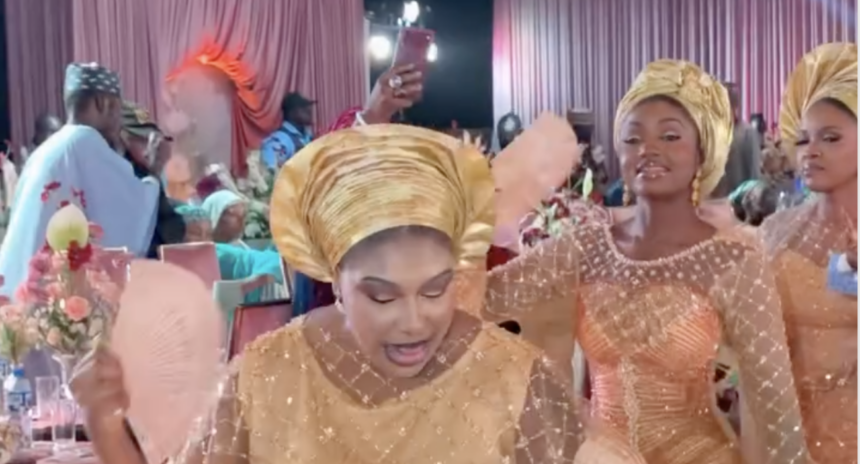
There is a moment at every Nigerian wedding when the music shifts, the crowd rises, and the air itself seems to hold its breath. The doors open. The MC’s voice booms over the speakers. And then she appears — not walking, but arriving, like a queen returning to a throne she never truly left.
The Nigerian bridal entrance is not simply a procession. It is theatre. It is cinema. It is a cultural declaration wrapped in lace, Aso Oke, coral beads, and a Gele sculpted so precisely it could withstand a hurricane. And it has become one of Nigeria’s most powerful exports — a phenomenon that dominates TikTok, Instagram, and YouTube, racking up millions of views from audiences who have never set foot on Nigerian soil but cannot look away.
The Anatomy of a Nigerian Entrance
Unlike Western weddings, where the bridal entrance tends toward the solemn and sentimental, the Nigerian entrance is a full-throttle celebration. The bride does not glide quietly to the altar. She dances. Sometimes she is escorted by a coordinated Asoebi train of bridesmaids in matching fabrics. Sometimes she is carried on a palanquin by cultural dancers. Sometimes she descends from the ceiling on a motorised platform. And on more than a few occasions, she has been wheeled in encased in a giant transparent inflatable balloon shipped from Dubai.
The music is never subtle. It is Afrobeats at full volume, or the thunder of a live traditional band, or a carefully curated mix that builds tension before exploding into pure joy. Professional MCs and hype-men treat the couple like rock stars arriving at a concert, whipping the crowd into a frenzy as the bride showcases choreography — a blend of rehearsed routine and viral dance moves — that flows perfectly with the rhythm.
And then there is the money spraying. As the bride advances, family and guests swarm the dancefloor, showering her with cash in a continuous, swirling storm of naira notes. It is a traditional symbol of blessing, prosperity, and affection. But to an outside audience scrolling through social media, it is also visually spectacular — the sheer volume of flying bills, combined with the couple’s unfazed, rhythmically flawless dancing through the cash storm, creates instant, highly shareable content.
Fashion as Spectacle
The sartorial display at a Nigerian wedding is a masterclass in luxury. Brides often boast three to four outfit changes across the course of the day, each more breathtaking than the last. Heavily beaded Aso Oke, regal George fabrics, custom lace corsetry, perfectly sculpted Geles, and traditional coral statement beads — every detail is deliberate, every stitch a statement.

When captured by specialised wedding content creators using slow-motion tracking shots, aerial drone angles, and cinematic colour grading, the resulting footage looks less like a home video and more like a high-budget music video. And that is precisely the point.
The Algorithm Rewards the Spectacle
Here is where the story gets interesting. The Nigerian bridal entrance has become a self-sustaining economic format, and social media algorithms are complicit.
As cultural critic Dami Oludumila observed in a piece for LinkedIn, the viral Nigerian wedding has developed a template: “Same colour palettes. Same aerial shots. Same slow-motion bridal train entrances. Same curated chaos that somehow looks identical across Lagos… just because the algorithm rewards familiarity. What performs once gets repeated until it becomes the template.”
That is a sharp observation, and it is not wrong. Because social platforms and aggregation pages generate millions of views for these formats, a massive ecosystem of vendors, makeup artists, planners, and content creators has emerged, all explicitly tailoring every entrance to hit the exact visual beats needed to capture global attention. The wedding is no longer just for the couple. It is for the feed.
And yet — there is something genuine beneath the curation. The joy is real. The dancing is real. The money spraying is real. The family members who storm the dancefloor are not performing for an algorithm; they are celebrating a daughter, a sister, a friend. The camera captures it, but it does not create it.
Why the World Can’t Look Away
Nigerian bridal entrances break the internet because they are the perfect storm: high-production luxury, cultural uninhibited joy, and algorithmic optimisation. They are not logistical moments designed to move a bride from point A to point B. They are cinematic performances designed to evoke shock and awe — in the room and on the feed.
These entrances are a source of immense pride for Nigerians. They showcase our fashion, our music, our choreography, our exuberance, our refusal to be quiet or small. For the outside world, they offer a glimpse of a culture that celebrates love with a fierceness and flair that is impossible to ignore.
But perhaps the most important thing they reveal is this: in Nigeria, a wedding is not just the union of two people. It is a community’s chance to show up, to show out, and to remind the world that we know how to celebrate like nobody else.
The Walk That Conquered the World
So the next time a Nigerian bridal entrance appears on your timeline — the bride in her sculpted gele, the Asoebi train in perfect formation, the money flying through the air like confetti, the MC screaming into the mic — pause for a moment. What you are watching is not just a wedding. It is a culture at its most confident, broadcasting itself to the world in full colour, at full volume.
And the world, quite rightly, cannot stop watching.